
Complexity, like a creeping vine, can strangle the life out of a project if not pruned in time.
But in simplicity, there is clarity—a clear path that winds directly to the solution, free from unnecessary twists.
By stripping away excess, we reveal the true essence of what needs to be done.
“Simplicity holds the key to lasting efficiency.”
The Temptation of Complexity
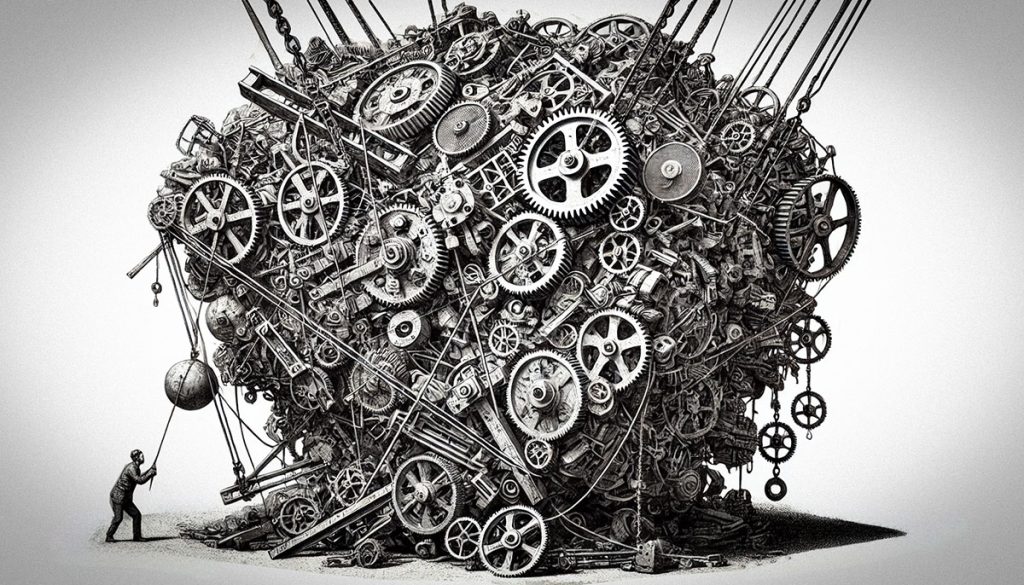
“Even the smallest ripple can start a storm.”
In the rush to solve problems, it’s tempting to add more features, address every possible contingency, and cover every edge case. But often, each layer of added complexity only creates more points of failure, more confusion, and less maintainability.
Developers are drawn into this labyrinth, believing that more is better—yet it’s often the simple solutions that prove enduring and effective.
The truth is, every additional feature increases the weight a system must carry, slowing it down and leaving it vulnerable to breaking under its own ambition.
The Elegance of Simplicity

Simplicity isn’t just about minimalism for its own sake; it’s about honing in on what’s truly necessary. Whether it’s following the Agile methodology, Lean principles, or the KISS principle (“Keep It Simple, Stupid”), simplicity aligns with focusing only on what delivers value.
Cutting away the excess isn’t a sign of weakness—it’s a demonstration of precision, clarity, and foresight. The result? Solutions that are easier to maintain, faster to deliver, and more reliable.
Feature Creep: The Silent Saboteur

Feature creep starts innocently enough—a request for a “small” enhancement here, a new button there. Yet each addition, however well-meaning, can snowball into a tangled mess.
What was once a clean, efficient system becomes bloated, unmanageable, and prone to delays.
Projects go over budget, deadlines slip, and the original vision is lost in a sea of unnecessary functions. The best way to prevent this? Vigilance, discipline, and a commitment to simplicity.
The Practical Benefits of Simplicity

“The lightest load is the easiest to carry.”
When systems are simple, they are more maintainable. Fewer moving parts mean fewer bugs, faster development, and reduced costs over time.
Simple designs also ensure better performance and scalability, enabling teams to respond more quickly to change.
By focusing on core functionality, development teams build solutions that solve the real problems without getting bogged down in the unnecessary.
Simplicity doesn’t mean cutting corners; it means knowing which corners are worth keeping.